KOKI - CHALLENGING NEW TECHNOLOGIES - JAPANESE
 
Product infomation About us Exhibition Link Sales network Top
Technical memo

Environmental policy
Contact us

Top > Technical memo > A New Material Solution for On-Board Automotive Electronics

A New Material Solution for On-Board Automotive Electronics

Joint Cracking the Problem?

As the European Restriction of Hazardous Substances (RoHS) directives come into force in July 2006, the transition to lead-free solder is being made at an increasingly rapid pace. Many manufacturers have already adopted Sn-Ag-Cu (SAC) type solder as a representative lead-free solder for consumer appliance production.

The mechanical properties of SAC solder differ greatly from those of conventional Sn-Pb solder. At the beginning of lead-free substitution, SAC displayed high creep strength. It was believed that this would be sufficiently effective for soldering reliability, but as many users conducted reliability tests預nd as it was actually used for products and market data became available幼oncerns about its durability began to be raised. It is now known that cracks in SAC joints progress quickly.

After many years of working with automotive suppliers and manufacturers, we have developed a higher reliability lead-free solder designed to stand up to the more severe environments to which on-board automotive electronics are exposed. This article details our solution, for the first time, to the North American market.

The Demands of Automotive Electronics

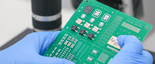
A wide and expanding range of on-board electronic devices are used in automotive applications, including car audio, car navigation and GPS, engine control, power windows, and monitors for electronic toll collection.

Figure 1: Automotive Electronics

For soldering mounting on vehicles, environmental tests that assume use at severe temperature and humidity conditions are conducted in consideration of device use in various regions. These tests include high temperature and low temperature repetition (i.e., heat cycling), high temperature, and high humidity. Especially for the engine compartment, exposed to severe conditions such as rainwater, and for critical devices whose failure could lead to injury or death of vehicle occupants, the resistance to heat cycle required by automotive manufacturers is very demanding: 3000 cycles or more at ・0ー to +125ーC.

How Thermo-cycling Causes Solder Cracks

Solder cracking due to thermo-cycling can be considered as follows:

Assume the case where a 3216 chip resistor is subjected to a heat cycle of ・0ー to +125ーC. Using the low side as a reference, there is a temperature difference of 165ー up to 125ーC. The thermal displacement of parts and board (1) is the product of the difference in thermal expansion coefficients between parts and board (a) and temperature difference (T) and package size (1).

1 = a x T x 1 mm

In this case, the solder between the parts and the board must absorb a thermal displacement of 3.7 オm. This displacement works as shearing force, and cyclic shear occurs to promote metal fatigue羊esulting in cracking of the solder.

The larger the part or larger the difference in thermal expansion coefficient between the part and the board, the more the stress load is applied to the solder, leading to solder cracking. But in addition to thermal displacement, a change in the crystalline state occurs because of the heating of solder alloy, making it difficult to estimate the fatigue life of the solder.

Figure 2: The Mechanism of Solder Cracking

A Material Choice

While Sn-3Ag-0.5Cu (SAC305) is used as a lead-free solder for ordinary consumer electronics purposes, there are many concerns about its mechanical properties and thermal fatigue characteristics for use in on-board automotive devices.

New research conducted by Koki and its automotive industry partners points to a high-durability anti-crack alloy of SAC with special metals added to increase durability as superior for on-board automotive devices. By integrating added trace elements to SAC, the resultant anti-crack alloy provides superior strength and shock absorption.

We are proposing S3XNI alloy as this solution. S3XNI is made by adding trace elements of nickel (Ni) and indium (In) to the conventional composition of SAC.

There are three reasons for selecting this alloy as a candidate for a high-durability damage resistant, anti-crack alloy:

First, the structure should not be too different from the original SAC composition. The preponderance of recent lead-free development is based on SAC; market data has been accumulated on the material, with results available to manufacturers. If one investigated compositions radically different from SAC, data on the design, reliability, functionality, etc. of SAC would not be useful, and new data would have to be generated and analyzed from square one for the new material. S3XNI has an alloy composition based on SAC and is advantageous in that it can be handled in virtually the same way as SAC.

Second, elements added should be ordinary and harmless. Even if an element has good characteristics, it cannot be established as an environmentally friendly lead-free solder if it is harmful. Use of an unknown metal may raise serious concerns about reliability to users. For S3XNI, well-recognized metals (i.e., Nickel and Indium) are adopted as the added metals. Nickel has been used for plating and has long been closely related to soldering. Demand for it is increasing for TIO (tin indium oxide, used for liquid crystal panels); but though it is expensive due to its small reserves, this will not be a problem because the added quantity is very small. SnAgBiIN type solder using indium was used for the portable mini-disc (MD) player by Matsushita, a mass produced product using lead-free solder for the first time in the world. The results of the metal in the market are sufficient endorsement for its use.

Third, as noted above, the quantity of the elements added should be very small. This is related to the first reason, and the aim is to hold the added quantity to the minimum necessary amount for assuring durability預nd to make characteristics other than durability equivalent to those of SAC.

Figure 3: The Logical Composition of S3NXI

Test Results

Figure 4 below shows a cross section of a 3216R chip after 1000 cycles at ・0ーC to 125ーC. SAC has large cracks in the fillet portion and chip back, while cracking for the high durability anti-crack alloy is controlled, through some strain is found. The 1000 cycle test confirms the superiority of S3NXI.

Figure 4: Cross section comparison: SAC vs. S3XNI

Figure 5 shows cross sections to 3000 cycles. SAC is completely broken through at about 2000 cycles, resulting in conductivity failure. In contrast, the joint state of the solder paste using S3NXI retains continuity after 3000 cycles, though some crack progress is observed.

Figure 5: Cross section comparison at 3000 cycles

Development of a Corresponding Flux

When the high-durability alloy is formed into solder paste, paste characteristics may change due to the effect of the added metal.

For the S3NXI alloy, Nickel and Indium are the added elements. They bring a very large positive effect for the joining durability of the alloy itself, but they also have some negative aspects when handled as solder paste.

It is known that indium has high reactivity. Even a very small amount (e.g., 0.5%) added to the alloy may have some effect. We have developed and sold a solder paste containing indium (SB6N58-A730) for a number of years. In developing a flux for S3NXI, we leveraged reaction-controlling technology developed for this earlier flux to control the reactivity of indium. As a result, the shelf life was improved and viscosity change when printing was controlled.

Figure 6: Viscosity variation in continual printing

For flux used in on-board automotive devices, it is necessary to secure reliability of insulation in an atmosphere of high temperature and high humidity, and also when dew occurs. To meet these requirements, we have developed a 田rack-free flux・which does not crack in the flux residue throughout the heat cycle.

This flux also has the effects of controlling electromigration due to moisture entering through the residue crack, as well as preventing the residue from entering switches or other elements and causing contact failure. It addition to these preventative benefits, the flux also has a beneficial coating effect.

Figure 7: Comparison photo: Flux residue after 1000 cycles; conventional versus crack-free flux

It is very difficult to develop a flux having such crack-free residue.

Flux used for soldering contains rosin. Rosin is a material that has long been used for soldering, and it is special in that it has insulating properties while having an acid value (related to wettability) and a function best suited for soldering flux. On the other hand, its shortcoming is that rosin use results in a flux residue that tends to crack due to its inherent hardness and brittleness.

To make the flux residue crack-free, the brittleness of rosin must be improved upon first. To do this, we reduce the ratio of rosin and add an additive for plasticity. For the reduced portion of rosin, an activator must be added to compensate for the reduced wettability, to the extent that electrical reliability will not be compromised.

The paste made by mixing solder powder with the flux produced by adjusting the plasticizer components預nd blending so as to prevent residue cracking at low temperature and deterioration at high temperature擁s 田rack-free・solder paste.

###

Atushi Irisawa works for the Soldering Technology Division of Koki Company Ltd. Comments or questions regarding this article may be sent to info@ko-ki.co.jp

Atushi Irisawa
Koki Company Ltd.

 
KOKI COMPANY LIMITED
Copyright (C)2005 KOKI Company Ltd. / All rights reserved.